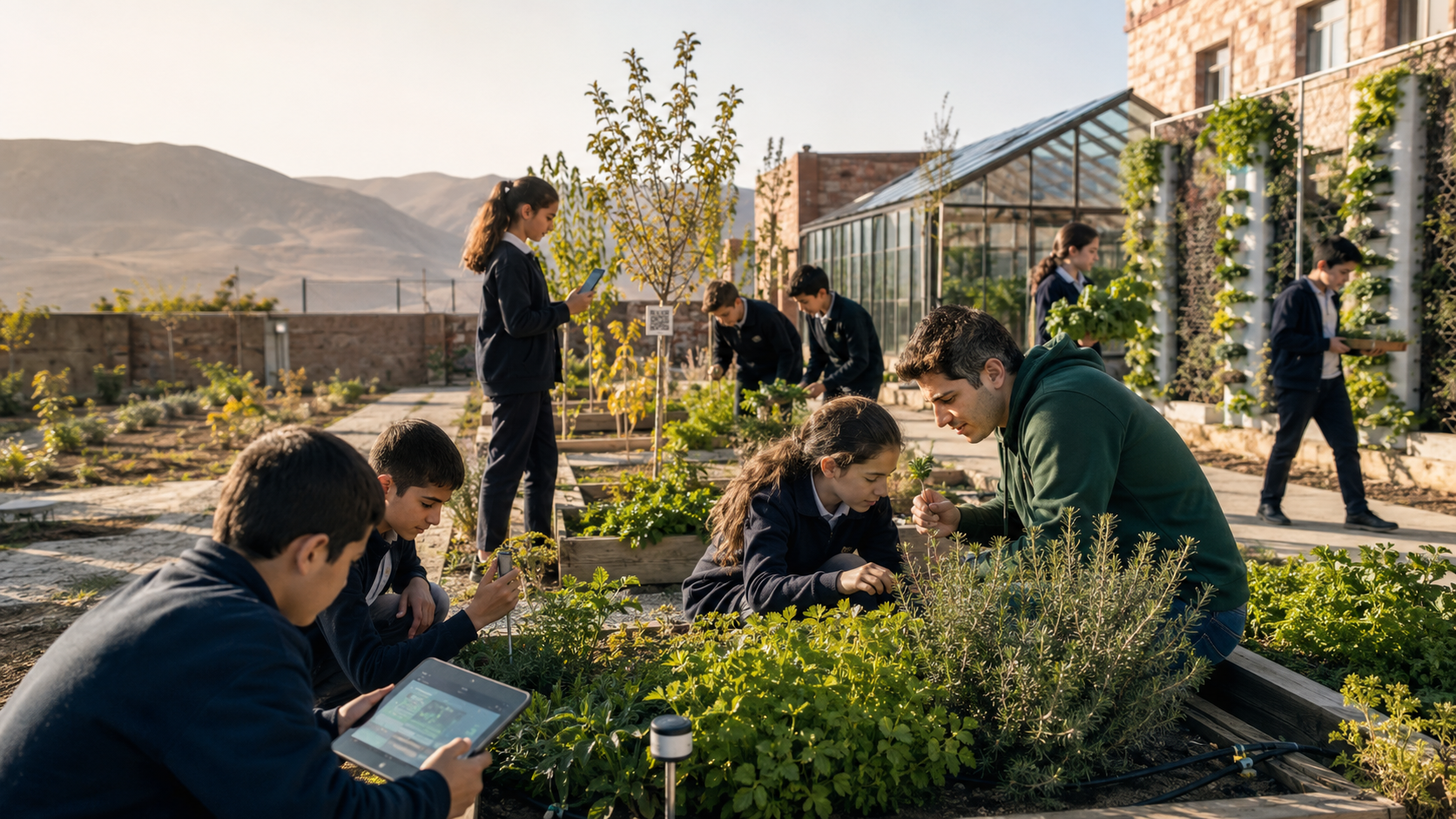
It is always exciting to imagine the future and picture what our cities, homes, neighborhoods, and schools might look like.
So, what could the school of the future be like? Greener, more vibrant, and more connected to nature. A place where the school garden becomes an outdoor classroom for observation and practical learning, where the greenhouse serves as a small laboratory, and where school meals are prepared using organic produce. It is a school that advocates for environmental care while equipping children with practical knowledge and skills they will carry with them throughout their lives.
This vision inspired the "Green School: Armenia. Your Idea for the School of the Future" competition, held from February to March 2026. The competition was organized by the United Nations World Food Programme (WFP), the School Feeding and Child Welfare Agency, Russia’s Social and Industrial Foodservice Institute (SIFI), and the Armenian National Agrarian University. Experts from the Armenia Tree Project also took part in assessing the submissions. The initiative is being implemented as part of Armenia's School Feeding Programme and its Transformative Home-Grown School Feeding component.
The competition brought together students from the Armenian National Agrarian University. Their task was to develop a project for a specific school by studying its grounds and existing conditions, assessing available resources, and proposing a practical solution focused on creating a greener school environment, improving school meals, and promoting sustainable development.
Projects could focus on transforming schoolyards, developing school gardens or greenhouses, creating green learning spaces, or introducing ideas that connect child nutrition with locally produced food, nature, and education. The key requirement was that each proposal should go beyond an abstract concept and present a solution that could be further refined and implemented in school life.
A total of eight projects were submitted. Although they differed in concept and approach, they all shared a common goal: to make school a place where children learn not only from textbooks but also through active participation in school life — observing, experimenting, asking questions, taking responsibility, and gradually developing a deeper understanding of the world around them.
The competition formed part of the preparations for COP17, which Armenia will host in October 2026. The conference will focus on protecting land and natural resources, promoting sustainable agriculture, strengthening food security, and engaging young people and local communities in meaningful action.
All of these themes are closely connected to school meals. What ends up on a child’s plate matters. The way produce is grown, delivered, and prepared affects not only the quality of school meals but also children's attitudes toward food, work, and their connection with nature.
Selecting the finalists was no easy task. Each of the eight projects brought its own strengths and fresh ideas. The jury praised the students for their creativity, thoughtful understanding of the school environment, and commitment to developing practical, realistic solutions. Four projects advanced to the next stage.
Four ideas moving forward
The highest-scoring project was “Agroforestry System as a Model for a Green School” . It was developed by Elen Kazaryan, Laura Avetisyan, Elen Barseghyan, Mane Melkonyan, and Tigran Mnatsakanyan.
The project proposes creating an agroforestry system on the school grounds, a space where trees, agricultural crops, and learning areas are combined into one practical model. The area would include green zones, educational trails, outdoor learning spaces, and plots for growing plants.
This model would help schools use their outdoor areas for educational purposes. Children would be able to explore soil, water conservation, composting, biodiversity, and sustainable land use through hands-on activities. The project also aims to make the school environment greener, improve the local microclimate, and encourage children to develop a more thoughtful relationship with nature.
The second selected project is “SmartGrow: Smart School Greenhouse”. The idea belongs to Grisha Khurshudyan, Artur Hovakimyan, Dianna Khachatryan, and Lianna Khachatryan.
The team proposes upgrading the school greenhouse with an automated management system that monitors and adjusts key growing conditions, including irrigation, temperature, and humidity. This would make plant cultivation more precise, help save water and energy, and reduce the daily workload for greenhouse maintenance.
For schools, such a greenhouse could become more than just a place to grow vegetables or herbs. It could also serve as a learning environment where children observe how plants respond to different conditions, workwith sensors, analyze data, and see how innovative technologies are applied in agriculture. In this way, practical horticulture, environmental education, and engineering skills come together, making the greenhouse a valuable part of the learning process.
The third project is “Green Learner Corner: A Vertical Garden at School”. It was presented by Lilit Harutyunyan, Tigran Atabekyan, and Gegham Manukyan.
The team proposes creating a vertical mini-garden at school, a compact green space for growing herbs, medicinal and decorative plants. This solution is particularly suitable for schools with limited outdoor space, as a vertical garden can be installed in a schoolyard, a well-lit indoor area, along a wall, or in a dedicated learning corner.
The project includes hanging, wall-mounted, and multi-level structures, along with a drip irrigation system. Children would be able to care for plants, observe their growth, learn about seasonal cycles, explore the basics of plant cultivation, and understand the importance of responsible water use. This format helps integrate practical lessons on ecology, biology, and healthy eating into everyday school life.
The fourth project is “Digital Mapping” authored by Alvard Hakobyan, Vanik Kyureghyan, and Mkrtich Hambardzumyan.
The project proposes creating a digital map of the school grounds featuring information about trees, plants, and natural elements. Children would survey the school area, photograph plants, identify species, prepare short information cards, and place QR codes with descriptions next to them.
This approach turns the school grounds into a practical space for exploring biodiversity. Children learn how to observe, collect data, use digital tools, and better understand the natural environment around their school. At the same time, the project does not require complex equipment. To get started, schools would only need smartphones, basic online tools, and teachers’ assistance.
As a result, schools could create their own “digital passport” of the school grounds, a living database of plants and green areas that children can continue to expand and use during biology, ecology, and geography lessons.
From projects to practice
The competition also featured other ideas that could be valuable for schools. These included projects focused on high-protein foods for children, school educational mini-farms, nutritious baked goods, cooperation with local farmers, and community involvement in school feeding.
Although these projects did not advance to the next stage, each contained practical elements that could be implemented separately: meetings with local producers, healthy food tastings, educational sessions on nutrition, farming, food origins, and responsible consumption. These activities do not require complex infrastructure but can help children better understand where their meals come from and why supporting local production matters.
This is where the competition demonstrated its unique value: it showed how broad the topic of school meals can be. Through this area, schools can open discussions about children’s health, environmental responsibility, local food systems, practical learning, and respect for the people who grow the food we eat.
The selected projects will now be further developed with the support of experts. The teams will refine their technical solutions, strengthen the school feeding component, prepare implementation plans, and develop presentations for COP17. The Armenian National Agrarian University will conduct professional evaluations to help make the ideas more precise, realistic, and ready for practical application.
The school of the future does not appear overnight. It begins with an idea, followed by a sketch, discussions with teachers, expert consultations, calculations, partner searches, and real-world testing. This is how an ordinary schoolyard can gradually become a true green learning space.
That is why this competition is important not only for university students. It demonstrates that young professionals already have ideas capable of transforming school environments while focusing on the everyday experiences and surroundings that shape children’s lives at school.
So, what could the school of the future be like? Greener, more vibrant, and more connected to nature. A place where the school garden becomes an outdoor classroom for observation and practical learning, where the greenhouse serves as a small laboratory, and where school meals are prepared using organic produce. It is a school that advocates for environmental care while equipping children with practical knowledge and skills they will carry with them throughout their lives.
This vision inspired the "Green School: Armenia. Your Idea for the School of the Future" competition, held from February to March 2026. The competition was organized by the United Nations World Food Programme (WFP), the School Feeding and Child Welfare Agency, Russia’s Social and Industrial Foodservice Institute (SIFI), and the Armenian National Agrarian University. Experts from the Armenia Tree Project also took part in assessing the submissions. The initiative is being implemented as part of Armenia's School Feeding Programme and its Transformative Home-Grown School Feeding component.
The competition brought together students from the Armenian National Agrarian University. Their task was to develop a project for a specific school by studying its grounds and existing conditions, assessing available resources, and proposing a practical solution focused on creating a greener school environment, improving school meals, and promoting sustainable development.
Projects could focus on transforming schoolyards, developing school gardens or greenhouses, creating green learning spaces, or introducing ideas that connect child nutrition with locally produced food, nature, and education. The key requirement was that each proposal should go beyond an abstract concept and present a solution that could be further refined and implemented in school life.
A total of eight projects were submitted. Although they differed in concept and approach, they all shared a common goal: to make school a place where children learn not only from textbooks but also through active participation in school life — observing, experimenting, asking questions, taking responsibility, and gradually developing a deeper understanding of the world around them.
The competition formed part of the preparations for COP17, which Armenia will host in October 2026. The conference will focus on protecting land and natural resources, promoting sustainable agriculture, strengthening food security, and engaging young people and local communities in meaningful action.
All of these themes are closely connected to school meals. What ends up on a child’s plate matters. The way produce is grown, delivered, and prepared affects not only the quality of school meals but also children's attitudes toward food, work, and their connection with nature.
Selecting the finalists was no easy task. Each of the eight projects brought its own strengths and fresh ideas. The jury praised the students for their creativity, thoughtful understanding of the school environment, and commitment to developing practical, realistic solutions. Four projects advanced to the next stage.
Four ideas moving forward
The highest-scoring project was “Agroforestry System as a Model for a Green School” . It was developed by Elen Kazaryan, Laura Avetisyan, Elen Barseghyan, Mane Melkonyan, and Tigran Mnatsakanyan.
The project proposes creating an agroforestry system on the school grounds, a space where trees, agricultural crops, and learning areas are combined into one practical model. The area would include green zones, educational trails, outdoor learning spaces, and plots for growing plants.
This model would help schools use their outdoor areas for educational purposes. Children would be able to explore soil, water conservation, composting, biodiversity, and sustainable land use through hands-on activities. The project also aims to make the school environment greener, improve the local microclimate, and encourage children to develop a more thoughtful relationship with nature.
The second selected project is “SmartGrow: Smart School Greenhouse”. The idea belongs to Grisha Khurshudyan, Artur Hovakimyan, Dianna Khachatryan, and Lianna Khachatryan.
The team proposes upgrading the school greenhouse with an automated management system that monitors and adjusts key growing conditions, including irrigation, temperature, and humidity. This would make plant cultivation more precise, help save water and energy, and reduce the daily workload for greenhouse maintenance.
For schools, such a greenhouse could become more than just a place to grow vegetables or herbs. It could also serve as a learning environment where children observe how plants respond to different conditions, workwith sensors, analyze data, and see how innovative technologies are applied in agriculture. In this way, practical horticulture, environmental education, and engineering skills come together, making the greenhouse a valuable part of the learning process.
The third project is “Green Learner Corner: A Vertical Garden at School”. It was presented by Lilit Harutyunyan, Tigran Atabekyan, and Gegham Manukyan.
The team proposes creating a vertical mini-garden at school, a compact green space for growing herbs, medicinal and decorative plants. This solution is particularly suitable for schools with limited outdoor space, as a vertical garden can be installed in a schoolyard, a well-lit indoor area, along a wall, or in a dedicated learning corner.
The project includes hanging, wall-mounted, and multi-level structures, along with a drip irrigation system. Children would be able to care for plants, observe their growth, learn about seasonal cycles, explore the basics of plant cultivation, and understand the importance of responsible water use. This format helps integrate practical lessons on ecology, biology, and healthy eating into everyday school life.
The fourth project is “Digital Mapping” authored by Alvard Hakobyan, Vanik Kyureghyan, and Mkrtich Hambardzumyan.
The project proposes creating a digital map of the school grounds featuring information about trees, plants, and natural elements. Children would survey the school area, photograph plants, identify species, prepare short information cards, and place QR codes with descriptions next to them.
This approach turns the school grounds into a practical space for exploring biodiversity. Children learn how to observe, collect data, use digital tools, and better understand the natural environment around their school. At the same time, the project does not require complex equipment. To get started, schools would only need smartphones, basic online tools, and teachers’ assistance.
As a result, schools could create their own “digital passport” of the school grounds, a living database of plants and green areas that children can continue to expand and use during biology, ecology, and geography lessons.
From projects to practice
The competition also featured other ideas that could be valuable for schools. These included projects focused on high-protein foods for children, school educational mini-farms, nutritious baked goods, cooperation with local farmers, and community involvement in school feeding.
Although these projects did not advance to the next stage, each contained practical elements that could be implemented separately: meetings with local producers, healthy food tastings, educational sessions on nutrition, farming, food origins, and responsible consumption. These activities do not require complex infrastructure but can help children better understand where their meals come from and why supporting local production matters.
This is where the competition demonstrated its unique value: it showed how broad the topic of school meals can be. Through this area, schools can open discussions about children’s health, environmental responsibility, local food systems, practical learning, and respect for the people who grow the food we eat.
The selected projects will now be further developed with the support of experts. The teams will refine their technical solutions, strengthen the school feeding component, prepare implementation plans, and develop presentations for COP17. The Armenian National Agrarian University will conduct professional evaluations to help make the ideas more precise, realistic, and ready for practical application.
The school of the future does not appear overnight. It begins with an idea, followed by a sketch, discussions with teachers, expert consultations, calculations, partner searches, and real-world testing. This is how an ordinary schoolyard can gradually become a true green learning space.
That is why this competition is important not only for university students. It demonstrates that young professionals already have ideas capable of transforming school environments while focusing on the everyday experiences and surroundings that shape children’s lives at school.